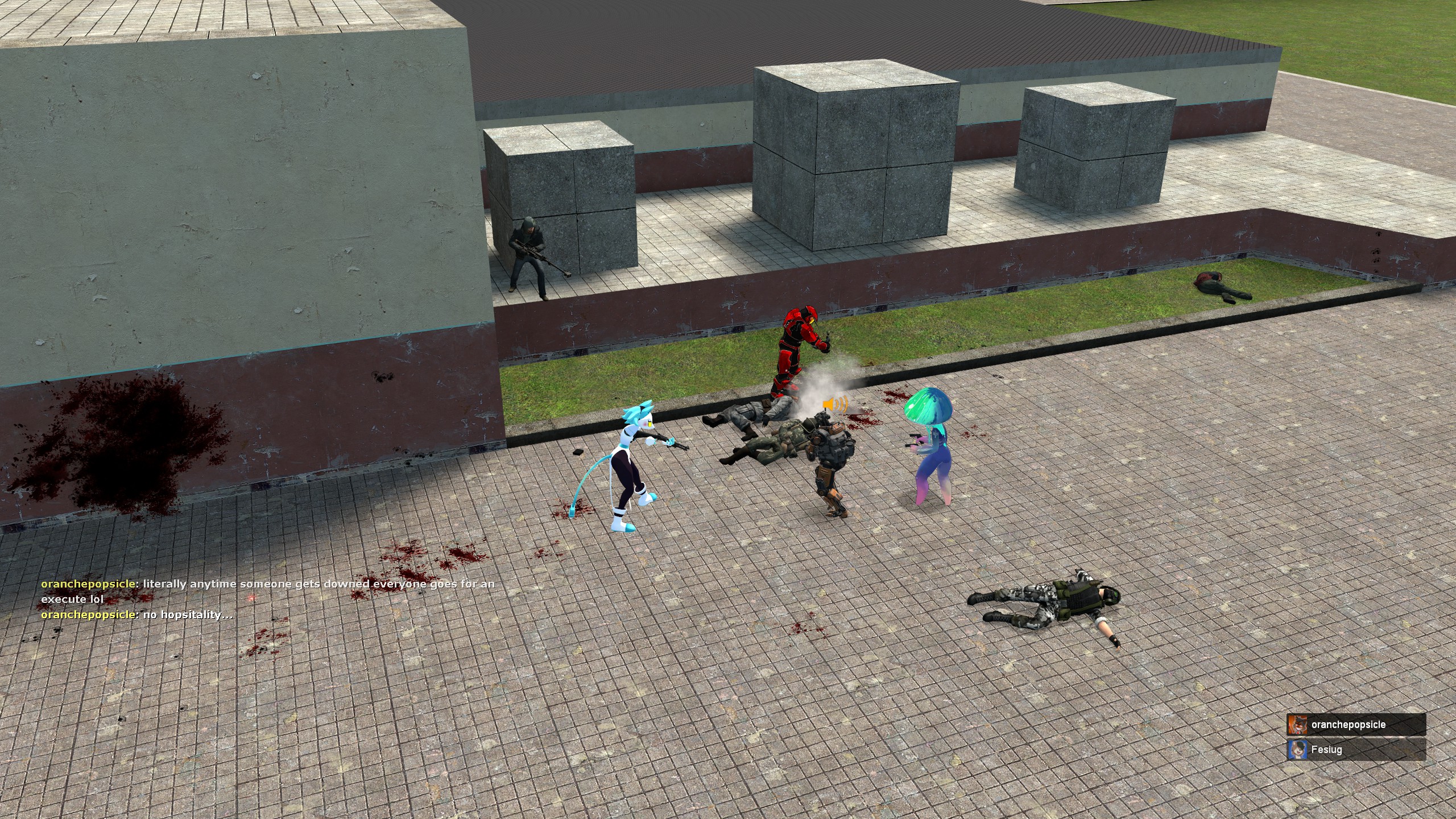
I remember why I started making mods.
It was not divine inspiration nor romantic ambition. To put simply, I paid for a roleplayer server in Garry’s Mod and felt I got fucking scammed. Seventy Chinese Yuan (enough for like two whole McDonalds meals back in the day) for some in-game money printers that barely work and “jobs” that don’t do anything besides have a bigger gun. I was pissed. Anyone can do this shit. I can do it better.
I was about 15 years of age at that point, just a naïve schoolkid with a fascination for PC gaming and the English-speaking side of the Internet. Chief among my fascination were two games: ROBLOX, which I have been playing since 2008; and Garry’s Mod, one of the first games my father got me on the burgeoning Steam platform. With access to my own computer (uncommon for the time) and fairly lax parents (an extreme rarity for sure), I had already begun to explore the possibilities of these games beyond just playing. Self-taught and driven by pure hyperfocus from my then-undiagnosed ADHD, I had plenty of experience but never finished any project for others to see. But on that day, I was really, really pissed off, and that was motivation enough.
It has been over a decade since that moment of spite. Modding became an integral part of my identity and shaped my life, and I know first-hand how impactful and rewarding it can be. But it’s hard to discuss it without actually defining what modding is, and also something similar in some respects but definitely isn’t modding.
The most straightforward definition of modding in the context of video games is its namesake: a modification of an existing video game. Whether it is the addition of content, changes to game mechanics, or replacing dragons with Thomas the Tank Engine, mods are built on top of an existing experience to enhance or replace it according to the creator’s vision. Importantly, mods rarely exist in isolation. It is typical for players combine different mods by different creators together for a transformative experience. Depending on the diversity of available mods, the changes to the game can range from purely cosmetic to an entirely different experience.
On the opposite hand, the most “game development” you can do without it being a job is making games for user-generated content (UGC) platforms, most exemplified by ROBLOX and Epic’s Unreal Engine for Fortnite (UEFN). Using these platforms, creators make a complete experience for players with near total control over gameplay just like traditional game development. What separates UGC platforms is that they often offer easy-to-use tools, prefab assets, and an existing playerbase to developers in exchange for their game only functioning under a closed ecosystem.
Despite having “mod” in its name, Garry’s Mod does not fit neatly into either category. It’s a standalone game with its own content and systems, namely the entirety of Half-Life 2 and its episodic sequels. However, its multiplayer community functions more like a decentralized UGC platform, where each server is a curated gameplay experience built through a collection of mods without being part of a closed ecosystem. Garry’s Mod isn’t not the only game in this position, but this flexibility, as well as its abundant amount of ported content, is what gave Garry’s Mod its claim to fame.
Okay, Garry’s Mod is a special case, who cares?
The unique qualities that make modding appealing becomes lost the farther you stray towards game development. The fact that you don’t have to make an entire game start-to-finish significantly lowers the barrier of entry for modding. You don’t need to know how to make a first-person shooter if all you want to do is add a Desert Eagle to Fallout 4, for example. You don’t even need to learn modelling and animation from scratch – just port them from another game you like! If you’re interested in game balance or design, an existing game will have a suite of gameplay mechanics and systems for you to tinker with without needing programming acumen.
But this advantage is also its greatest limitation. Mods are, for the most part, non-commercial ventures that live in the shade of the original game (even if it literally depends on mods to be playable, ahem New Vegas). For most modders, that is a perfectly adequate tradeoff for a hobby, but the line between “ambitious mod of a video game” and “actual video game” can get quite blurry at times.
Being neither a traditional moddable game nor a true UGC platform, Garry’s Mod hits a sweet spot between ease of development and creative potential, and this results in a situation that benefits all the stakeholders in the community. Modders with the skills to create content but don’t necessarily want to commit to making a whole experience can create pieces of independent work to combine with others. Community owners who wish to create complete, curated experiences can utilize the wide array of existing mods instead of having to build systems and content from scratch. Players who don’t create content can either pick and choose mods and curate their own experience, or join community servers for a more polished experience made by another person or team.
It cannot be overstated how dramatically customizable Garry’s Mod is. Even an average player with no technical skills can assemble a game out of disparate addons that have nothing to do with each other. Combine an addon that spawns a lot of zombies and an addon that adds a weapon shop and currency, and you have a horde shooter. Replace the shop with an inventory system and randomly spawning loot, and you have a survival game. For the enterprising server owner with technical know-how or the resources to hire someone who does, it is very much feasible for an individual to piece together a complex and ambitious experience out of the many pieces of systems Garry’s Mod has to offer, a task that would be impossible if they had to develop and make all the mods by themselves. If profitability is a concern, there is even a paid storefront for mods specifically catered to community servers that provides ready-to-use payment, lootbox and skin systems, which many communities use to solicit “donations” for in-game benefits.
If you read the last sentence and thought “charging for content you did not make sounds legally dubious”, you would be completely reasonable. The scale of these servers are often too small for any copyright holders to take notice, and so they’re left to their own devices. Most Garry’s Mod servers operate in this a grey area, but this is not a unique situation. FiveM, a roleplay-oriented modification of GTA V, also has various communities vie for success in a manner Rockstar is probably displeased with. FiveM has a long and troubled backstory that I am in no position to tell; but by contrast, it is fortunate that Valve maintains an permissive attitude towards modding.
It would be remiss of me not to point out that this attitude is not a kindness, but rather the last throes of a legacy that started all the way back with Doom. id Software had a hacker-culture mentality, distributing demo copies of their game as freeware and openly encouraging modifications and creation of content for their game. Building the GoldSrc and later Source engine off of Quake, Valve was similarly keen on supporting modifications of their games, famously hiring the team behind several mods that would become prolific game franchises of their own. Scroll through the list of video games derived from mods on Wikipedia, and you will find that the majority were derived from a game built in these two families of engines. Garry’s Mod is itself one such mod, of course – being originally a sandbox modification of Half-Life 2.
Source 2, Valve’s latest engine, does not share in the family tradition. While Source 2 games have no shortage of modding tools or interest, there is no Garry’s Mod equivalent or development toolkit for those who wish for more creative freedom. Alas, Valve offers nothing but its signature radio silence.
So, when Facepunch announced s&box, a platform built on the Source 2 engine made with modding and UGC in mind, no amount of skepticism would overcome my curiosity.
Because of my existing body of work on the Garry’s Mod Workshop, I received an invite from another modder and gained access to s&box in early development. I have some development experience with the engine, but I am not involved in the game’s community.
To preface with the boring stuff: s&box is, from a technical standpoint, competent. Its biggest appeal is hot-loading of C# code, allowing code changes to apply to an actively running instance of the game. This is similar to what is possible in Garry’s Mod, and far more agile than traditional game engines that require minutes to stop the game, recompile, and start again. Using a proper OOP language instead of a scripting language also means it is far easier to write robust, maintainable code compared to Garry’s Mod, which is important for larger projects and teams. Lastly, being built on Source 2 means s&box has access to a suite of mature content pipeline tools, including the Hammer level editor for S2, which is just genuinely delightful to use compared to other mainstream engines.
While s&box can mount games just like Garry’s Mod, its set of built-in assets leave much to be desired. There is a tiny selection of models and maps and two sets of characters. For players without the original games, this is a far cry compared to the combined variety of Half-Life 2 and Counter-Strike: Source.
The most glaring omission from s&box is its fundamental inability to have “mods”. Experiences you find on the platform are offered as is, and can’t be modified without going into an editor and changing the project. Assets can be streamed in at runtime, but the inability to simply add a chunk of code to your current game without having it being a whole new project is a deeply painful omission.
The most common criticism about s&box that I hear from fellow modders as well as most of the playerbase (besides it not being like Garry’s Mod) is that it’s trying too hard to be ROBLOX. There’s two things to unpack here: How is s&box like (and unlike) ROBLOX, and why is that a bad thing?
First, the similarities. s&box is, unlike Garry’s Mod, unambiguously a UGC platform. Like ROBLOX, it has a listing of games and a discovery algorithm to boost them. Like ROBLOX, it allows users to customize a standardized avatar across different games on its platform using accessories that you trade using a premium currency (Steam wallet is basically Robux right?). Like ROBLOX, it tries to financially support its creators with revenue sharing.
To Garry Newman’s credit, he has been forthright about s&box not being a sequel to Garry’s Mod but rather a platform for creators, and I believe he is genuine in his intentions in supporting creators through s&box and isn’t doing this purely for profit (Rust prints money, he’ll be fine).
Against his credit, he is seemingly completely oblivious to why people create things in the first place.
Whether it is modding or making UGC content, the primary motivation behind creators of derivative content is passion. They like the original game, or they have an attachment to their platform. Most modders, myself included, aren’t interested in or expecting to profit from their work, so s&box’s appeal – the possibility of creating monetizable, standalone games from scratch – is completely lost to us. Community owners who may be financially motivated also struggle to find footing in s&box, as they don’t have a wealth of existing content to depend upon. Furthermore, as a new platform with no existing games, s&box lacks a playerbase to potentially convert into aspiring developers.
Thus, the only people left who care about s&box are developers who are brave, desperate or foolish enough to try their luck in a creator ecosystem and place themselves upon the mercy of the algorithm. Like other content creation platforms, s&box uses discovery algorithms to push content that drives the most profit and/or engagement. This has two consequences.
Firstly, it results in an extreme top-heavy revenue distribution. For ROBLOX, out of an estimated 3.1m monetizing developers, only the top 10,000 creators earn ~$50k-100k USD annually, a wage comparable to full-time employment in the US. Fortnite’s UGC platform is just as grim, with ~400 creators who got a payout of over $100k USD out of ~70k total creators in 2024. While these rates may be more appealing for creators in countries with weaker currencies, it is still a tiny, tiny fraction of all creators.
Secondly, the need to appease an algorithm results in a race-to-the-bottom for UGC games. Without an already established game, many developers try to chase trends by mass producing low effort games with quick turnaround times, most commonly in the form of incremental games. This genre of game is by far the most common on ROBLOX under the “simulation” genre, which has about the same amount of games on the platform than the next four most popular genres combined. If you’ve read this article this far, I think I am safe in assuming you are someone who cares about the quality of video games and would agree that these kinds of games are less desirable, even if they are more profitable to the platform owner.
While the decision to use an algorithmic discovery algorithm is reasonable, Facepunch’s decision to ship with a paid cosmetics system is downright ridiculous to me. This does not help game creators in the slightest except by generating revenue for the game that may indirectly be given back to creators via revenue distribution. But, putting the cash register before the horse is a terrible look, especially on a paid game with little else to offer. I can only imagine the success of Rust had deluded Garry into thinking this is a great idea.
While s&box is not technically a closed ecosystem, with the ability to compile games made with it independently to be sold on Steam (with Valve approval), nothing else about it encourages people to use it like a game engine. Right now, it has an front page powered by a discovery algorithm like ROBLOX, a revenue distribution system optimizing for playtime just like ROBLOX, and an avatar system with paid cosmetics just like ROBLOX.
So, if it looks like a duck and quacks like a duck…
Once it became clear that s&box’s direction would not change for the better, my interest in it faded, and I went back to the familiar stomping grounds of my beloved Garry’s Mod. I continued to make mods for it and other games, even as I found a full-time job in tech and later in the video game industry, with s&box being nothing but a passing memory.
In April 2026, s&box released on Steam to little fanfare.
Its flaws were immediately apparent on launch, and it received a Mixed rating that remains at the time of writing. In a post-launch article, Garry listed and addressed common complaints raised by negative reviews. The most common criticism pertained to s&box’s nature as a UGC platform and not a moddable game, with the inevitable comparison to Garry’s Mod being drawn. In response, Garry claims (emphasis mine in bold):
[The reviewers] didn’t want an engine and a platform. They wanted a Source 2 SDK, they didn’t want a modern c# engine built on top of Source 2. I don’t think we can win in that argument, it’s going to be an expectation and preference thing. My only real hope is that eventually everyone will realise that this is a much better way to work for developers, and we’ll end up with much better content because of it.
So, the inability for s&box to support mods is not a mistake, but rather an intentional decision by Garry to facilitate the creation of original experiences. He echoes this sentiment in an interview with Daryl Baxter:
The problem with Garry’s Mod was that it was a dead end for developers. If I were a developer now, I wouldn’t learn or create any code for Garry’s Mod, because the skills aren’t transferable and there’s no exit plan. If you make the most popular game in Garry’s Mod, you are going to end up remaking it in Unity and trying to sell it on Steam.
Wait a second! I’m a game developer who transferred my skills from Garry’s Mod into my job as a game developer, and I’m currently working for an indie game in Early Access that was [checks notes] also originally conceptualized as a gamemode for Garry’s Mod. Funny how that works.
Extremely specific but anecdotal counter-examples aside, I think it’s fair to say that for nearly all Garry’s Mod creators, their work begins and ends with the game. Where Garry gets it wrong is extrapolating that into the idea that modders are somehow dissatisfied by the state of things, and wish to expand their horizons to making “real games”.
Despite my hypocrisy in stating this as a modder who ended up making video games, most modders don’t want to do game development. One’s a hobby and the other’s a job. You would not need to transfer their skills or have an exit plan for your hobby. Making stuff for Garry’s Mod is easy thanks to all the mods, and the fact that the output has to stay within the game is a tradeoff everyone understands implicitly.
For the scant few modders with true ambitions and a winning idea, s&box also fails to appeal. I disagree with Garry and believe that a modder’s skills are easily transferrable. A programmer proficient in the fundamentals through one language will not have trouble learning another; a 3D artist, animator or sound designer would already be using the same tools for Garry’s Mod as they would for other games; and game designers can obviously work with any software. Countless professionals in the industry started off making mods, myself included. On the contrary, it is far harder to justify learning a new, proprietary and unproven engine instead of existing engines and tools.
I don’t want the takeaway of this article to be “never make anything on s&box because it sucks balls”. I do not think s&box is without merit or doomed to irrelevance. Though hindered by a shotgun marriage with a UGC platform nobody asked for, it is still a functional game engine with distinct advantages. There are many well-made, enjoyable games on the platform that aren’t rip-offs or low-effort shovelware.
At the end of the day, it’s not a big deal whether s&box succeeds or fails. At worst, it becomes a missed opportunity. Garry’s Mod will continue to exist, and I will probably keep coming back to it for many years to come.
Perhaps what bothers me so strongly about s&box is that it is proof that Garry fundamentally does not understand why his namesake game is so beloved by players and modders. In trying to be a spiritual successor to Garry’s Mod, s&box has instead become its antithesis.
The modders who make self-contained content at their leisure and the players who enjoys combining mods together are asked to drop their act, get it together, and make real games like real developers, as if that was something they ever wanted.
“Join our game jam! Look at our prize pools! You can release it on Steam!”
I have to admit, it feels like being spit in the face.